
If you're brand new to short-form video, you're not really choosing between two apps. You're choosing a growth model.
TikTok is a feedback engine. Fast testing, fast distribution, fast cultural momentum.
YouTube Shorts is a library engine. Distribution plus search plus "evergreen" discovery, with a clearer path to long-form content, subscriptions, and revenue systems that stack.
The best beginner move in 2026: Start with one platform for focus, but publish on both for learning. Then double down where you get traction.
And if you're already editing one vertical clip, it's rarely worth not posting it twice (assuming you package it correctly).
This guide is up to date as of January 2026. Monetization rules and platform features change often, so treat this as a living document you can return to.
How to Choose Between TikTok and YouTube Shorts in 5 Questions
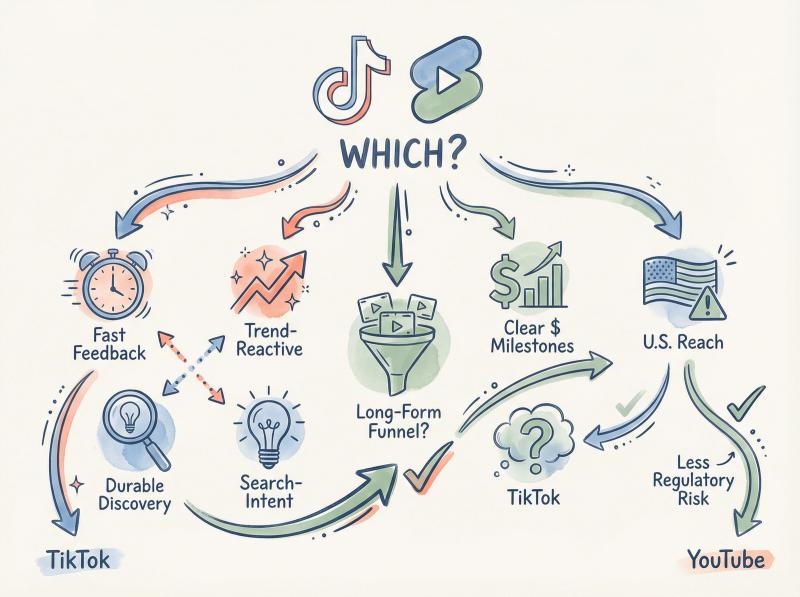
Answer these 5 questions. Your answers tell you where to start.
1) Do you want "fast feedback" or "durable discovery"?
- Fast feedback (trend waves, quick iterations, rapid virality tests) = TikTok
- Durable discovery (search plus recommendations that can resurface content for months) = YouTube Shorts
2) Is your content trend-reactive or search-intent?
- Reacting to trends, stitching/dueting, commentary, culture = TikTok
- Tutorials, explainers, product demos, "how to," niche knowledge = YouTube Shorts (and YouTube overall)
3) Are you building a funnel to long-form video?
If yes, YouTube Shorts has a built-in advantage because Shorts live inside the broader YouTube ecosystem.
4) Do you want the clearest monetization milestones?
YouTube publishes clear eligibility thresholds for program tiers. TikTok monetization exists in multiple forms, but which ones you can access depends heavily on country and program availability.
5) Are you posting from the U.S. (or dependent on U.S. reach)?
TikTok has faced unique regulatory risk in the U.S. In late 2025, major outlets reported a deal structure intended to keep TikTok operating in the U.S., with a closing date around January 22, 2026.
For a beginner, the practical takeaway is simple: don't build your entire business on a single platform.
What Beginners Actually Care About (and What Experienced Creators Wish They'd Known)
How TikTok and YouTube Shorts Handle Growth and Discovery
TikTok
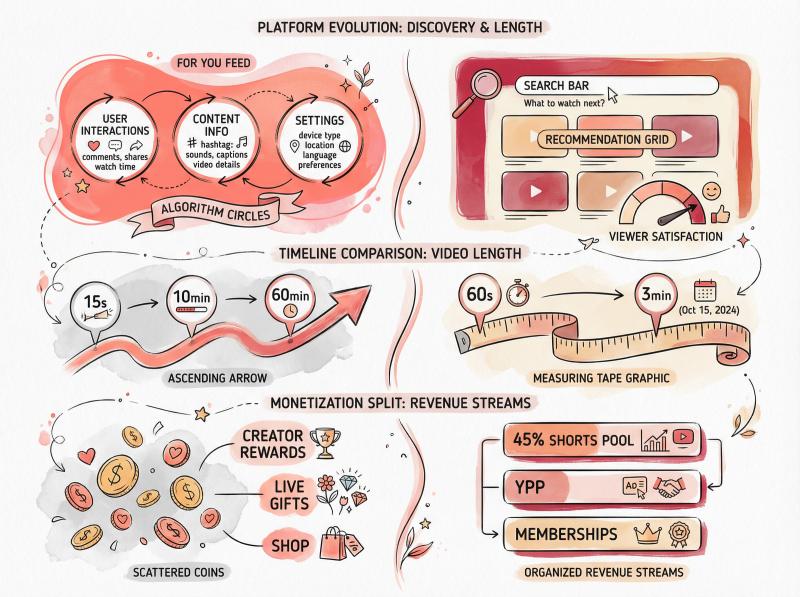
Discovery is heavily centered on the "For You" feed. The platform describes recommendation signals in three broad buckets: (1) user interactions, (2) content information, and (3) user/device/account settings.
This creates a strong "cold start" experience. Even new accounts can get meaningful distribution if the video performs.
YouTube Shorts
Shorts are distributed via YouTube's recommendation surfaces, and YouTube emphasizes "viewer satisfaction" as a core principle for recommendations.
You also get the structural advantage of YouTube: the same channel can host Shorts and long-form, playlists, search-discoverable content, etc.
Video Length Rules You Need to Know (2026 Update)
YouTube Shorts Length
YouTube treats vertical or square videos up to 3 minutes as Shorts if uploaded on/after Oct 15, 2024. (YouTube Help)
If you post 3-minute verticals, this matters because it changes how content is categorized and distributed.
TikTok Length
TikTok states that recorded videos can be up to 10 minutes, and uploaded videos can be up to 60 minutes. (TikTok Support)
That doesn't mean you should post 60-minute TikToks as a beginner. But it shows TikTok isn't "only short" anymore.
How Music and Copyright Work on Each Platform (A Beginner Trap)
YouTube Shorts Plus Music
YouTube's Shorts system has specific rules around music usage (and Content ID claims). For example, YouTube warns that Shorts longer than one minute with an active Content ID claim can be blocked.
If you're repurposing content with copyrighted audio, this is a key reason many creators keep certain Shorts under 60 seconds or use royalty-free/audio library options.
How to Actually Make Money on TikTok vs YouTube Shorts
YouTube
Shorts revenue sharing exists inside the YouTube Partner Program (YPP) and uses a pooled revenue model. YouTube states creators are allocated 45% of the revenue allocated to creators for Shorts.
YPP has "earlier access" thresholds (fan funding and shopping) and "full" thresholds (ads plus premium revenue share).
TikTok
TikTok's Creator Rewards Program is positioned as a program designed to help creators earn more by posting original, high-quality content. TikTok explicitly tied it to longer content (over a minute) and emphasized metrics like originality and engagement in its launch announcement.
TikTok also lists other monetization avenues like TikTok LIVE and creator/brand collaboration programs (availability varies by region).
What Counts as Success for a Beginner?
Most beginners say "I want views." But the real beginner goal is:
Build a repeatable content machine that produces 30 to 60 "shots on goal" in 30 to 60 days.
Because one viral hit teaches you less than 20 controlled experiments.
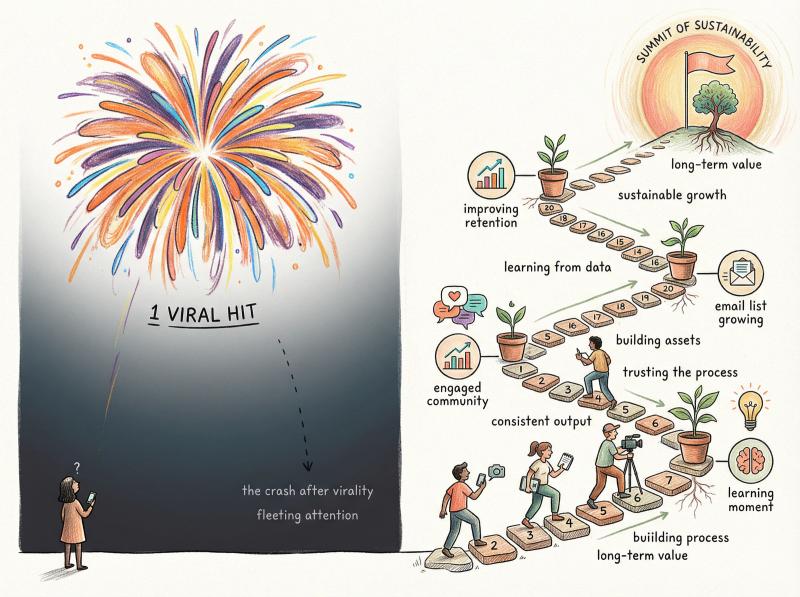
Success looks like:
- You can produce 3 to 5 posts per week without burning out
- You understand your niche's "winning" structure (hook → value → payoff)
- Your analytics show improving retention and consistent comments/shares, not just random spikes
- You're building an off-platform asset (email list, website, product waitlist, etc.) so platform volatility can't wipe you out
The 2026 Rules You Must Know Before You Post Your First Clip
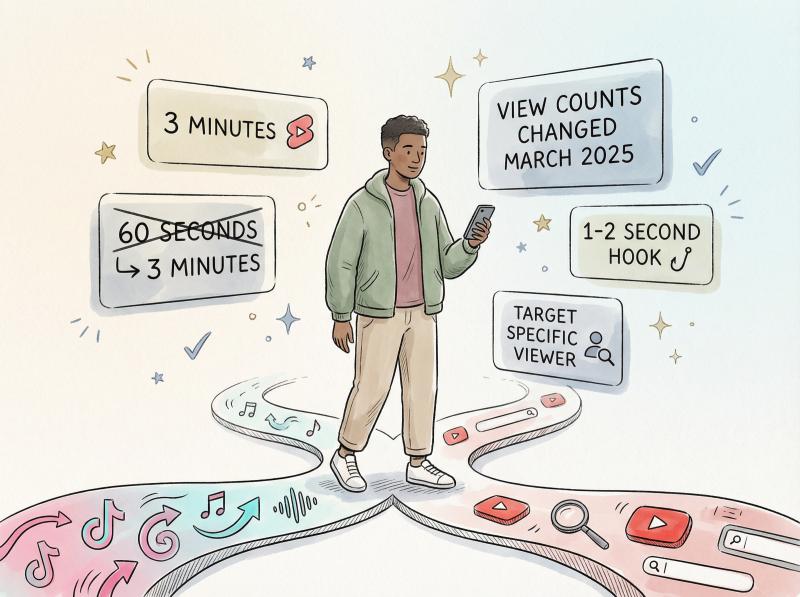
YouTube Shorts: How Length and View Counts Changed in 2025
1) Shorts can be up to 3 minutes (with important classification details)
YouTube's help documentation explains the 3-minute Shorts rules and the Oct 15, 2024 cutoff for this classification behavior.
2) View counting changed for Shorts
YouTube states that as of March 31, 2025, Shorts "views" are counted as the number of times a Short starts to play or replay, while "engaged views" remain available in analytics. (YouTube Help)
For beginners, this means your "views" number may look bigger than older Shorts metrics. You still need to watch retention/engagement metrics to know if a video is actually working.
TikTok: How the Algorithm Recommends Content (and What Beginners Should Do)
TikTok's own recommendation explanation highlights:
- User interactions (e.g., things you watch, like, share, comment on)
- Content information (captions, sounds, hashtags, etc.)
- And account/device settings (language, country)
For beginners, translate that into:
① Make the first 1 to 2 seconds unskippable
② Label the video clearly (on-screen text plus caption)
③ Target a specific viewer (not "everyone")
How to Qualify for Monetization: The Real Thresholds (and Timeline)
Most beginner creators should build monetization in this order:
- Service / product / affiliate (you control it)
- Email list / community (you own it)
- Platform payouts (bonus, not foundation)
Still, you should know the thresholds so you can plan.
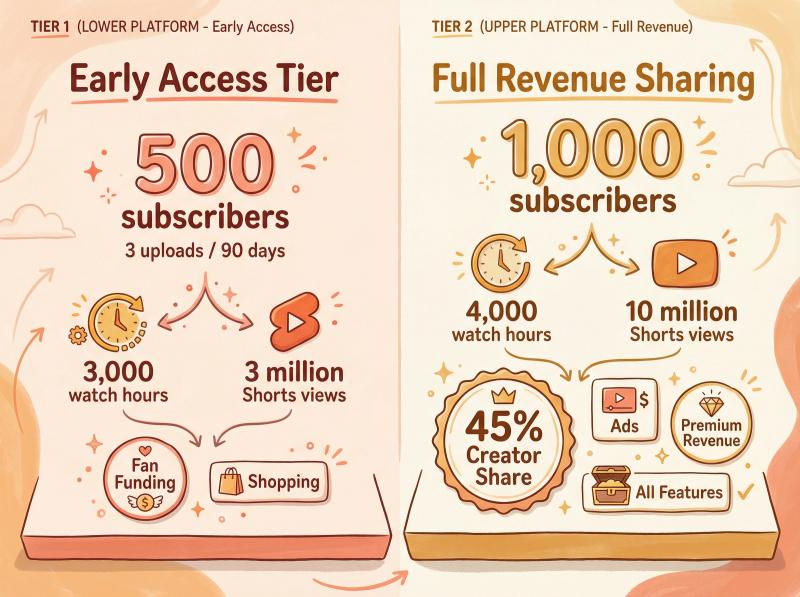
YouTube Monetization: What You Need to Start Earning
YouTube's expanded YPP has a lower entry point for certain features:
500 subscribers plus 3 uploads in 90 days, plus either:
- 3,000 watch hours in 12 months, or
- 3 million Shorts views in 90 days
For broader ad revenue sharing benefits, YouTube lists:
1,000 subscribers, plus either:
- 4,000 watch hours in 12 months, or
- 10 million Shorts views in 90 days (YouTube Partner Program)
Then, Shorts ad revenue sharing uses a pooled model and YouTube states a 45% creator share of allocated Shorts revenue.
TikTok Creator Rewards: What the Platform Actually Pays For
TikTok's launch announcement for Creator Rewards described it as designed to help creators generate "higher revenue potential" and specifically emphasized longer videos (over a minute) and reward factors like originality, play duration, search value, and engagement.
Beginner takeaway: If you want TikTok monetization tied to the platform's longer-content incentives, you should build the ability to make high-retention 60 to 120 second videos, not just 7-second memes.
Who You'll Actually Reach on Each Platform (and Why It Matters)
You don't need perfect demographic charts to win, but you do need to understand the platform vibes.
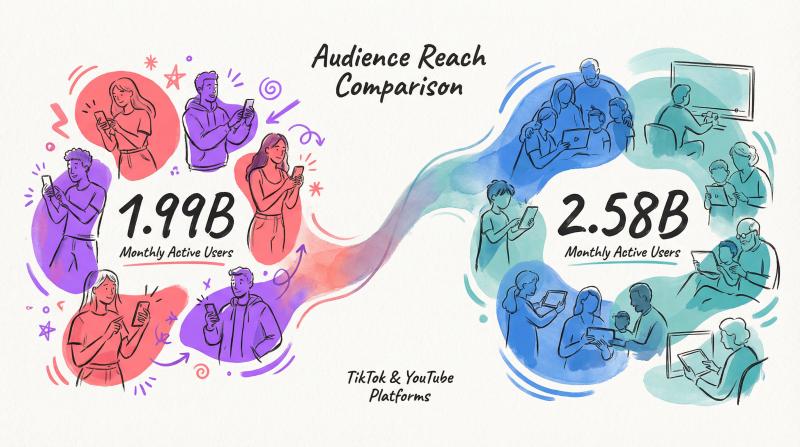
YouTube Reaches Everyone, TikTok Owns Younger Adults
Pew Research Center's Americans' Social Media Use 2025 reports that YouTube is among the only platforms used by a majority across all age groups surveyed, while TikTok usage skews much younger (and varies strongly by age).
For teens, Pew reported in Dec 2025 that about one-in-five teens say they use TikTok and YouTube almost constantly.
How Big Is the Audience? (Scale Snapshot)
Datareportal's global overview pages report (based on platform ad tools) that:
- YouTube's potential advertising reach is roughly 2.58 billion
- TikTok ads can potentially reach roughly 1.99 billion adults (18 plus) each month
Beginner interpretation: Both platforms are enormous. Your advantage won't be "being early." It will be being clear and shipping consistently.
The Beginner Strategy That Works on Both Platforms
If you only remember one thing:
Post once. Package twice. Learn fast.
"Posting once" = you create one core vertical video.
"Packaging twice" = you tailor the hook/caption/cover so the video feels native on both platforms.
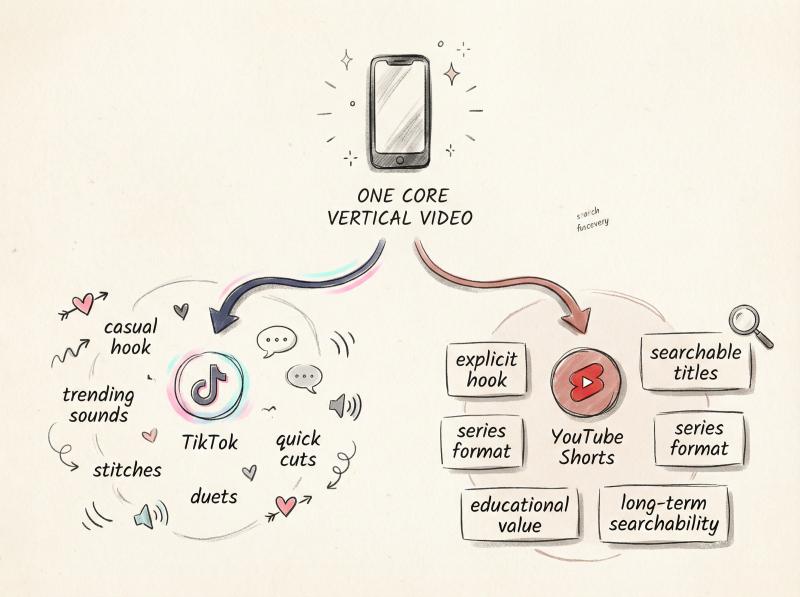
How to Package the Same Video for TikTok vs YouTube Shorts
| TikTok Packaging | YouTube Shorts Packaging |
|---|---|
| Hook can be more "casual" / conversational | Hook often performs better when it's explicit ("3 mistakes beginners make with X…") |
| Trends, sounds, stitches, and reactive formats often win | Titles can matter more than people think (because YouTube has stronger search discovery surfaces) |
| Comments are a huge growth lever (make it easy for viewers to respond) | "Series" formats often work well: Part 1, Part 2, etc. |
9 Beginner-Friendly Content Formats That Work on Both Platforms
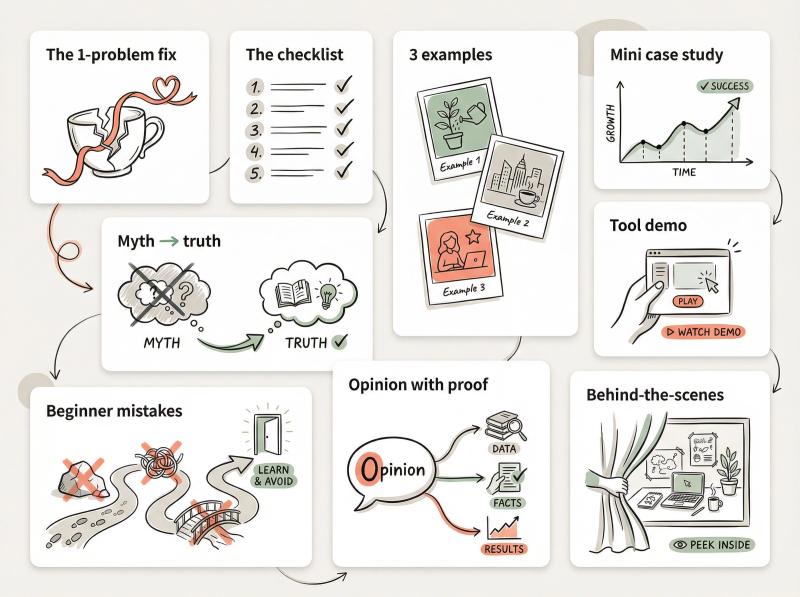
Pick 2 to 3 formats and stick to them for 30 days.
1. The 1-problem fix
"Stop doing X. Do this instead."
2. The checklist
"Before you ___, do these 5 things."
3. Myth → truth
"Everyone thinks ___. Actually, this is what's happening."
4. 3 examples
"Here are 3 great hooks you can steal…"
5. Mini case study
"I tried _ for 7 days. Results: _."
6. Tool demo
"This is how I do ___ in under 60 seconds."
7. Beginner mistakes
"I wasted 3 months doing this…"
8. Opinion with proof
"Unpopular opinion: ___. This is why."
9. Behind-the-scenes
"This is exactly how I made this video…"
Your 30-Day Beginner Plan (Simple Enough to Follow, Deep Enough to Work)
This is built for beginners with limited time and no fancy gear.
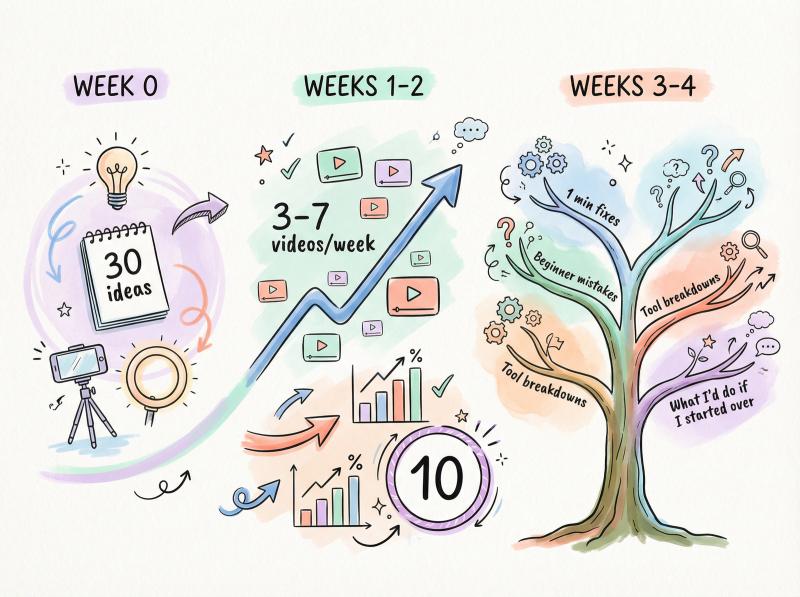
Week 0: Setup (One Afternoon)
- Choose a niche you can talk about for 100 videos
- Write your "channel promise" in one line: "I help [who] achieve [result] without [pain]."
- Make a list of 30 video ideas (use your Notes app)
- Create a repeatable filming setup (same background, same lighting)
Weeks 1 to 2: How to Find Your "Winning Structure"
Goal: publish enough to see patterns.
Posting pace:
- Minimum: 3 videos/week
- Ideal: 5 to 7 videos/week
- If you can only do 2/week, increase quality and commit for 90 days
Your job:
- Make 10 videos in one structure (same pacing, different topics)
- Track retention (do people stay?), comments (does it spark response?), saves/shares (does it deliver value?)
Weeks 3 to 4: How to Turn Winners into a Repeatable Series
Once you find a format that works, you don't need new ideas. You need variations.
Example series:
"1 minute fixes" | "Beginner mistakes" | "Tool breakdowns" | "What I'd do if I started over"
Your goal is to make the viewer think: "If I follow this person, I'll keep getting this specific value."
How to Cross-Post Without Killing Performance (and Why Post Bridge Helps)
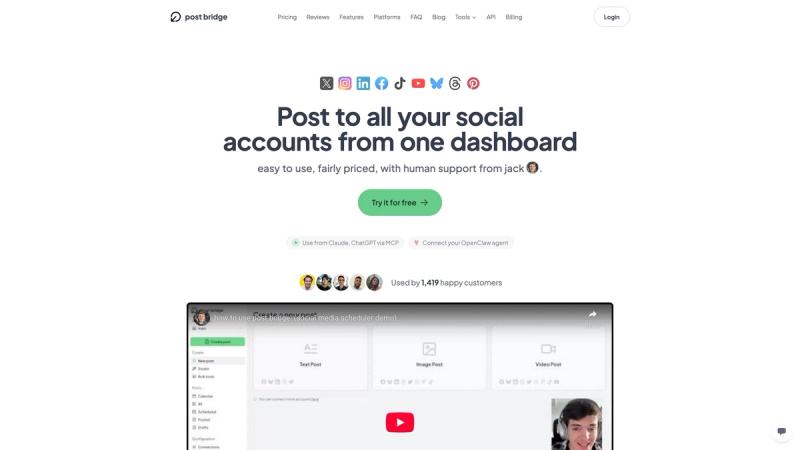
Post Bridge's actual dashboard - upload once, publish everywhere
Cross-posting is powerful, but beginners often do it wrong.
The "wrong" way:
- Download a TikTok with watermark
- Upload it everywhere
- Copy the same caption/hashtags
The "right" way:
- Export your clean master file (no watermark)
- Tailor packaging per platform
- Schedule consistently so you can actually stick with it
How Post Bridge Solves the Consistency Problem for Beginners
Post Bridge is built for the reality that beginners face: you're already spending time editing, and the bottleneck is publishing everywhere consistently.
With Post Bridge, you can upload once and schedule your vertical content across platforms (including TikTok and YouTube) instead of repeating the same workflow every day.
Why this matters:
Most creators fail not because their content is bad, but because they can't maintain consistency across multiple platforms. Manual posting to TikTok, then YouTube Shorts, then Instagram Reels, then Facebook, then LinkedIn burns hours every week.
Post Bridge solves this by letting you:
- Connect up to 9 social platforms (TikTok, YouTube, Instagram, Facebook, LinkedIn, Twitter, Pinterest, Threads, Bluesky)
- Upload your video once with platform-specific captions
- Schedule or instant-publish to all platforms simultaneously
- Save hours per week that you can reinvest in creating better content
For beginners juggling limited time, this means you can maintain consistent posting (which both algorithms reward) without sacrificing your sanity. Learn more about how Post Bridge simplifies multi-platform content distribution.
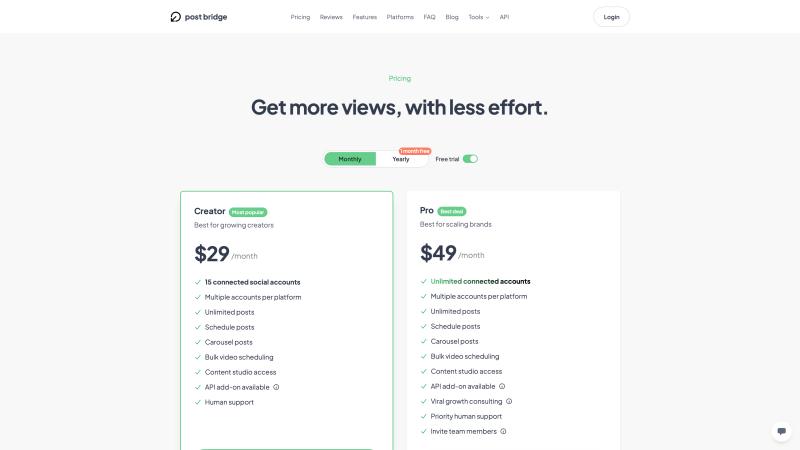
Post Bridge pricing - starts at just $9/month (vs Buffer's $54 for equivalent 9-platform coverage)
Important Post Bridge Limitations (So You're Not Surprised)
1) YouTube Shorts thumbnails
Post Bridge's help center notes that custom thumbnail selection isn't available for YouTube Shorts because YouTube's API doesn't allow cover selection for Shorts.
Beginner workaround: Put your "thumbnail" in the video itself: strong first frame plus clear on-screen text.
2) Platform-specific features
While Post Bridge handles the core posting workflow, you can't access every native platform feature through the tool. For example, TikTok's Duet and Stitch features still require using the TikTok app directly.
But for the core workflow (editing once, posting everywhere), it eliminates 80% of the repetitive work. Check out Post Bridge's free social media tools to enhance your workflow even further.
TikTok vs YouTube Shorts: Video Editing and Creative Tools
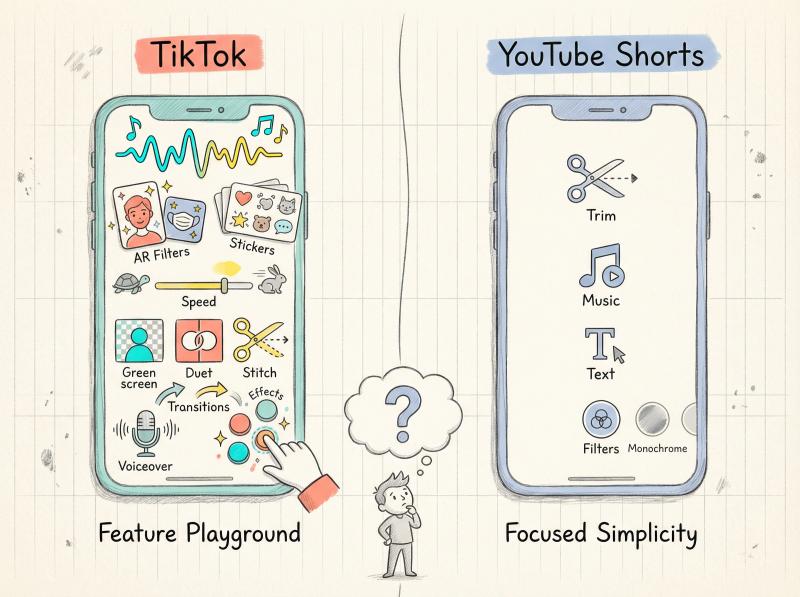
Both platforms let you shoot, edit, and share vertical videos using just your phone. TikTok, however, is famously robust in its editing features and interactive tools, while Shorts started simpler but is rapidly improving.
How Long Can Videos Be on Each Platform?
TikTok: Originally all about ultra-short clips (15 seconds), but now allows much longer uploads. You can record within TikTok for up to 10 minutes, and in some cases upload videos up to 60 minutes.
That said, shorter videos (under a minute) still perform best on TikTok for virality. Viewers come for quick hits of content.
YouTube Shorts: Launched with a 60-second limit, which it maintained for a long time, but as of late 2024 Shorts can be up to 3 minutes long.
This extension gives creators a bit more flexibility (e.g., you can do slightly more in-depth tutorials or mini-vlogs up to 180 seconds). Keep in mind that YouTube has stated their recommendation algorithm is still adapting to the new length.
Videos between 60 and 180 seconds on Shorts might not get pushed as effectively yet. As a beginner, it's wise to start with snappy sub-60s videos on both platforms, then experiment with longer formats once you have a feel for what your audience likes.
Which Platform Has Better In-App Editing Tools?
TikTok leads the pack. TikTok's editing suite is extremely feature-rich: you can trim clips, add captions and stickers, apply AR filters and funny effects, adjust speed, use transitions, green screen, voiceovers... basically everything, without leaving the app.
Importantly, TikTok's sound library is a huge draw: you have a vast catalog of music and viral sounds to use freely in your videos. Using trending audio is often key to getting views on TikTok (the algorithm sometimes boosts videos that use a currently popular sound).
TikTok also introduced creative tools like Duet (split-screen side-by-side with another video) and Stitch (clip a segment of someone else's video into yours as an intro) that fuel collaboration and trends.
On the other hand, YouTube Shorts started with more basic tools. You can record or upload a video, add music from a library (YouTube has a pretty extensive licensed music collection as well), add text, and do simple trimming.
They've been adding features like filters and some effects, plus a "Collab" tool similar to TikTok Duets which allows side-by-side videos. Shorts also introduced Q&A stickers for interactivity in comments.
Overall, TikTok still offers more playful creativity in-app. If you love editing on your phone with lots of effects, TikTok will feel like a playground. Shorts might require a bit more external editing if you want advanced effects (many Shorts creators edit in apps like CapCut or Adobe and then upload to Shorts).
Which is easier for beginners?
If you have no video editing experience, TikTok's editor can be a newbie creator's best friend. You can shoot and spice up a fun clip with music and effects in minutes.
Shorts is catching up, but you might find yourself doing a bit more work (either editing beforehand or just posting simpler cuts) when using Shorts' in-app tools.
On the flip side, Shorts' simplicity can be an advantage if TikTok's myriad features feel overwhelming. With Shorts you can focus on the content itself without getting lost in too many bells and whistles.
Many creators actually edit a video once (in TikTok or an external app) and then post the same file to both platforms using Post Bridge to save time.
How Content Gets Discovered: TikTok vs YouTube Shorts Algorithm
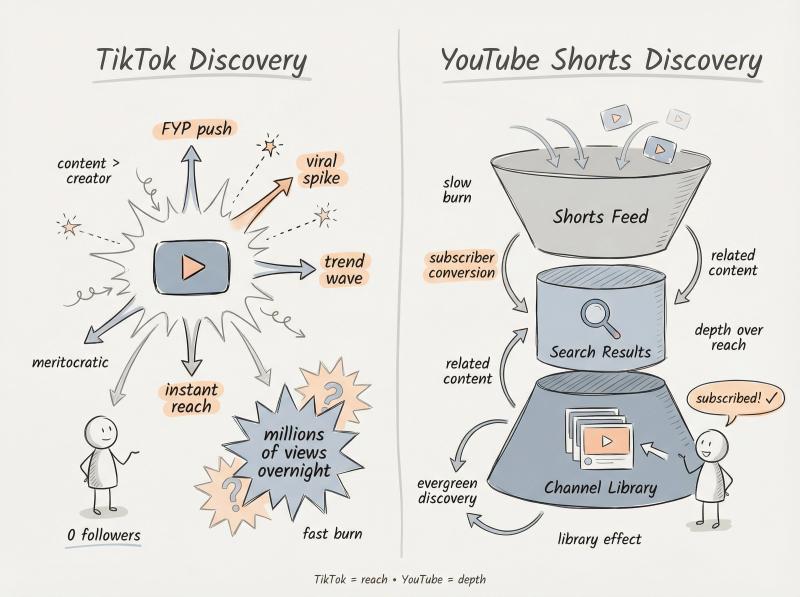
One of the biggest differences between TikTok and YouTube Shorts lies in how videos get discovered and go viral on each platform.
TikTok's Algorithm: How New Creators Can Go Viral Overnight
TikTok's For You Page algorithm is almost legendary. It's known for rapidly identifying engaging content and pushing it to large audiences, even if the creator is completely unknown.
In fact, TikTok prioritizes content over creator. A brand new account with zero followers can still get millions of views if the video triggers the right signals. Those signals include things like strong watch time (people watch the whole video), replays, likes, shares, and using trending sounds or hashtags.
The result is a very meritocratic system for virality: as a beginner, your first ever TikTok could theoretically explode overnight. This is hugely appealing if you want quick growth.
However, TikTok's focus on trends can be a double-edged sword. It often rewards hopping on the latest challenge or meme, so creators feel pressure to follow the trending topics to stay visible. Content on TikTok also has a fast burn rate: you might get a burst of traffic in days, then it could taper off quickly once the trend passes or the algorithm moves on to something else.
YouTube Shorts Algorithm: How Search and Subscriptions Work Together
YouTube Shorts feed - part of YouTube's larger search and recommendation system
YouTube's approach is a bit different. Shorts have their own dedicated feed for swiping, but they are also tied into the larger YouTube recommendation and search system.
The algorithm on Shorts still can provide a burst of views (some Shorts go viral in the feed), but it also considers factors like your channel's past performance and the searchability of content.
YouTube tends to be better at connecting viewers to related content or keeping them within a channel. For example, someone might watch your Short and then get recommended one of your longer videos, or they might find your Short via a Google search on a topic if you titled/keyworded it well.
In general, YouTube's algorithm is a bit slower burn. You might not get 1 million views in a day as easily as on TikTok, but a good Short can continue gaining views over weeks and drive steady subscriber growth.
It's also less purely trend-driven. Shorts that are informative or evergreen (not tied to a trending meme) can still find an audience via search and suggestions.
Discovery pros/cons for beginners:
TikTok offers the thrill of instant exposure. It's not unusual for new TikTok creators to see a spike of thousands of views on a creative video thanks to the algorithm's aggressive promotion of fresh content. This can be incredibly motivating early on.
On the downside, TikTok's feed is so good at showing users endless entertaining clips that building a lasting relationship with viewers is harder. Someone might love your video, but they're onto the next in seconds and might not follow your account unless you consistently appear for them.
YouTube Shorts tends to convert viewers into subscribers more effectively (you'll often see people comment "came from Shorts, just subscribed!"). The integration with your channel means if you have, say, a library of how-to videos or vlogs, a viral Short can drive people to binge your other content and become loyal fans.
In short, TikTok is superb for reach, YouTube Shorts is better for depth of engagement.
Tip: As a beginner, you might experiment with TikTok to test content ideas (thanks to its forgiving algorithm for new creators) and use Shorts to build your brand presence on YouTube. Many creators repurpose TikTok hits on Shorts. Sometimes a video that went viral on TikTok will also perform well on Shorts, or vice versa (and Post Bridge makes this cross-posting seamless).
How to Build Community: Engagement on TikTok vs YouTube Shorts
Engagement isn't just about views. It's about likes, comments, shares, and the sense of community you can build.
TikTok Engagement: High Energy But Fleeting
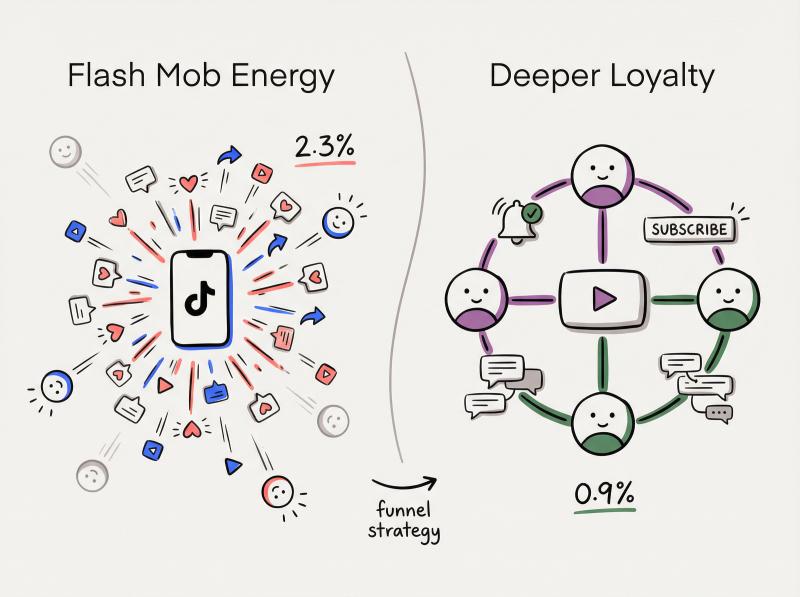
TikTok's engagement rates are famously high. By one study, TikTok commands an average engagement rate of around 2.3% per view, higher than what Shorts or Instagram Reels get.
People on TikTok are quick to interact. They'll leave comments (the average TikTok video gets more comments than an equivalent Shorts video), join comment trends, and share funny clips with friends.
TikTok's culture of duets and stitches also means engagement can turn into collaboration. Your viewers might create content with your original video, which amplifies reach.
The platform often feels like a big community riffing on trending sounds or challenges. For a beginner, this means if you strike the right chord (be it a relatable joke, a cool trick, or a heartfelt message), TikTok users might really run with it. You could get tons of comments or your audio could become a meme.
However, fostering a long-term community (like fans who watch everything you do) is tougher on TikTok. Many TikTok creators have millions of views but relatively few followers who actively keep up with them.
Think of TikTok engagement as flash mobs: high energy but a bit fleeting.
YouTube Shorts Engagement: Lower Rate But Deeper Loyalty
Shorts have a lower immediate engagement rate per view (around 0.9% in that same comparison study), meaning users scroll a bit more passively on YouTube.
Fewer people bother to comment on Shorts (on average) compared to TikTok, and the culture of sharing Shorts is less ingrained (viewers are used to the share buttons on TikTok; on YouTube, sharing tends to happen more with longer videos).
That said, YouTube's focus is to get users to subscribe or check out the creator's channel, which is a deeper form of engagement.
If someone subscribes after watching your Short, they're showing intent to see more of you, not just that one video. Also, YouTube's comment section can lead to more extended discussions or Q&A with your viewers because comments persist and are tied to your channel identity.
You might find you recognize some subscriber names who comment repeatedly. Essentially, Shorts might generate less buzz per video, but those who do engage are more likely to stick around as part of your budding community.
Which Platform Has Better Community Tools?
Both platforms allow you to interact with your audience via comments. TikTok lets you pin a comment, reply with a new video to a comment (a very cool way to engage: you can create a TikTok video answer to someone's question or remark).
YouTube lets you pin comments as well and of course, if you have other long videos, you can engage through those comment sections too.
Once you hit certain follower thresholds, TikTok unlocks features like going Live (you need 1,000 followers to go live on TikTok in many regions). YouTube's threshold for going live on mobile is lower (50 subscribers, as of recent updates) which is beginner-friendly.
As you grow, YouTube also has Community Posts (text/image posts to engage subscribers) once you pass 500 subs. TikTok doesn't have an exact equivalent of community tab posts (it's all video-centric).
Key takeaway: If you want lively interaction fast, TikTok is great for that initial spark. The comments and shares flow readily on viral content.
If you aim to nurture a loyal following that will follow you to bigger projects (like longer videos, other platforms, etc.), YouTube's ecosystem is better suited for building that kind of audience relationship over time.
Many creators use TikTok as a top-of-funnel for exposure and then funnel true fans to YouTube or other platforms (a strategy made infinitely easier with Post Bridge's unified scheduling dashboard).
How to Actually Earn Money: TikTok vs YouTube Shorts Monetization
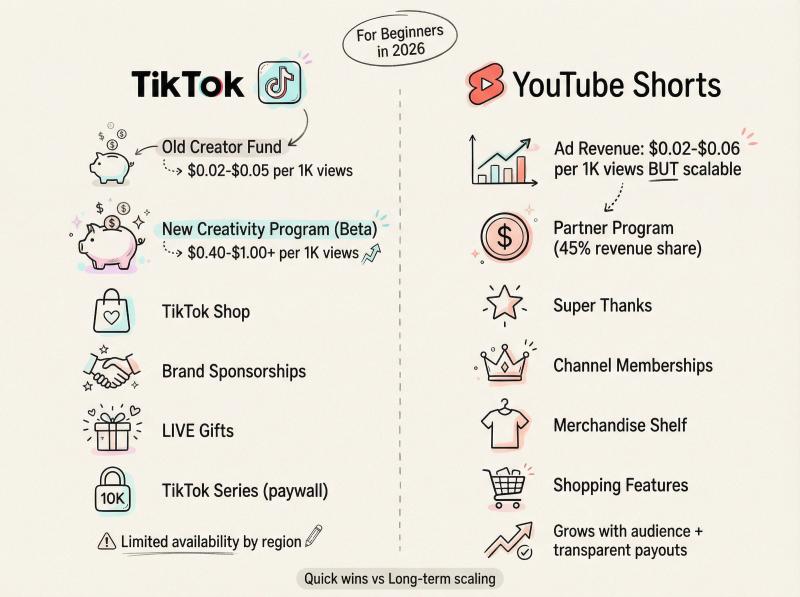
If you're a beginner, making money might not be your first priority, but it's good to know how each platform supports creators financially, especially if you plan to grow your presence.
Monetization is an area where YouTube Shorts currently has an edge in long-term potential, while TikTok offers some options but has historically been hit-or-miss.
TikTok Monetization: What You Can Actually Earn
TikTok introduced a Creator Fund in 2020, which set aside money to pay creators based on views and engagement. However, the payouts from the old Creator Fund were notoriously low and static. Many TikTokers reported earning just a few cents for every thousand views (e.g., $0.02 to $0.05 per 1,000 views was common).
In 2023 to 2024, TikTok revamped this into the TikTok Creativity Program (Beta), which has stricter eligibility (you usually need a certain follower count and 18 plus age, and it's only in select countries so far) but promises better revenue share.
Under the new program, TikTok reportedly pays around $0.40 to $1.00 plus per 1,000 views for qualifying videos (especially longer videos over 1 minute) (a dramatic improvement).
Translation: a viral TikTok with 1 million views might earn a few hundred dollars under the new program, whereas under the old fund it might have earned only $20 or less.
Keep in mind not every creator is eligible for this yet, and TikTok's program isn't as transparent or globally rolled out as YouTube's.
Outside of these funds, TikTokers often monetize via brand sponsorships and partnerships (which you handle on your own or through influencer agencies) and through TikTok LIVE gifts (viewers send you coins or gifts during live streams that convert to real money).
TikTok has also launched TikTok Shop and affiliate links, integrating e-commerce so creators can earn commission on products sold through their videos.
Additionally, a feature called TikTok Series allows eligible creators to put premium content behind a paywall (fans pay to access a collection of your videos), but this requires having a decent following (e.g., 10k followers).
For a beginner, the main takeaway is: you likely won't earn meaningful money from TikTok until you have significant views and followers, and even then, direct TikTok payouts may be modest unless you're in the new program and making longer content.
Many TikTokers leverage their fame to earn money indirectly (sponsorships, directing traffic to a business, etc.) rather than relying on TikTok's built-in payments.
YouTube Shorts Monetization: How the Partner Program Works
YouTube, of course, has long had the YouTube Partner Program (YPP) for monetizing traditional (horizontal) videos with ads. In early 2023, they extended this to Shorts.
To monetize on YouTube, you need to meet eligibility criteria: traditionally it was 1,000 subscribers and 4,000 watch-hours (for long videos), but for Shorts they added an alternate path (1,000 subscribers and 10 million Shorts views in 90 days).
(Note: as of 2025, YouTube has also piloted a lower tier of 500 subscribers for some features, but the main ad revenue sharing still needs roughly 1000 subs.)
Once you qualify, YouTube shares ad revenue from ads that play between Shorts in the feed. On a per-view basis, Shorts ad revenue pays quite little (often on the order of $0.02 to $0.06 per 1,000 views for many creators).
That might sound worse than TikTok, but there's a catch: YouTube's monetization is scalable and transparent. Every view contributes some ad revenue, and as your channel grows you can also earn through Super Thanks, channel memberships, merchandise shelf, and other features that YouTube enables for monetized channels.
Importantly, YouTube's ad revenue isn't a fixed fund (it grows with advertiser demand). In fact, YouTube Shorts collectively get an astronomical 50 plus billion views per day (as of 2023), and YouTube has been improving Shorts ad payouts over time.
The real power move on YouTube is to use Shorts to boost your channel and then monetize through longer videos and other streams. YouTube's ecosystem allows a short video to bring in subscribers who later watch your 10-minute videos that earn far higher CPMs (dollars per 1000 views).
Additionally, YouTube now allows shopping features on Shorts (e.g., product tags and affiliate links connected to Google's e-commerce tools), which creators can use to earn commissions, similar to TikTok Shop.
And analytics-wise, YouTube gives far more data on revenue, viewer behavior, etc., which can help you as a creator understand what's making money and why.
Which Platform Pays More Long-Term?
For a sustainable creator career, YouTube tends to be more lucrative. It's not uncommon to hear that creators with the same viral video on both platforms made double or more on YouTube what they did on TikTok.
One reason is that YouTube's monetization scales with audience (if you have a loyal following, you can earn through many avenues: ads, memberships, sponsorships on YouTube, etc.).
TikTok's direct payouts, while improving, still favor certain types of content (the TikTok Creativity Program, for instance, rewards longer engaging videos, meaning educational or narrative content does better than quick gags).
If you're a beginner thinking long term, you might lean toward building up YouTube, where your content library (both Shorts and longs) can generate passive income over time.
TikTok, on the other hand, might pay more per single view in the short run for some creators (especially if you crack into their new rewards program), but it doesn't (yet) offer the same ecosystem of revenue streams.
Monetization takeaway: Don't worry about this on day one. Focus on making good content and building an audience.
But it's good to know that if your goal is to earn money as a creator, YouTube Shorts is generally the better bet for consistent, long-term revenue.
TikTok can be fantastic for exposure and even quick cash if you land brand deals or hit it big in the new fund, but many TikTokers eventually direct their followers to YouTube or other platforms to diversify their income.
In fact, the smartest creators use both: e.g., make a viral TikTok series, then upload highlights to Shorts and ultimately funnel engaged fans to a monetized YouTube channel or another revenue source (all while using Post Bridge to automate the cross-posting workflow).
TikTok vs YouTube Shorts: Pros and Cons for Beginners
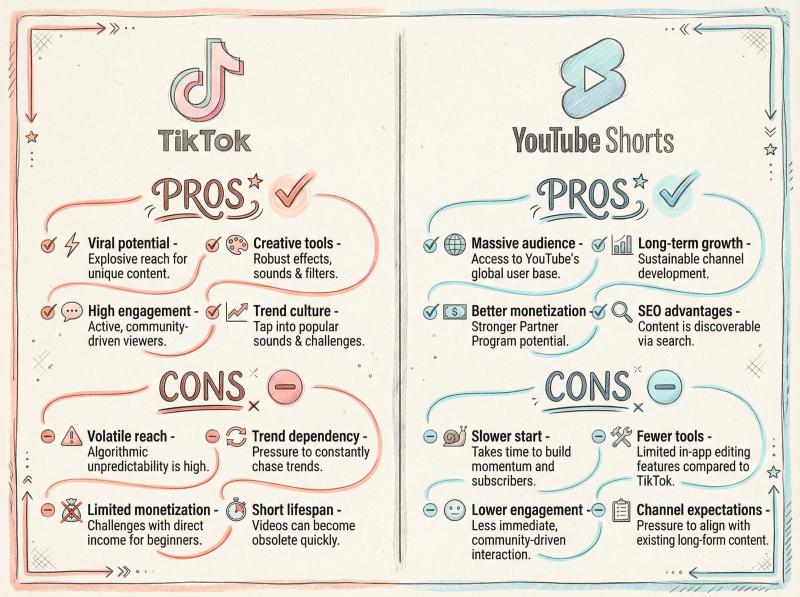
To help you decide, this is a quick summary of the advantages and disadvantages of TikTok and YouTube Shorts for beginner creators:
Why TikTok Is Great for Beginners
Unmatched viral potential for new creators
The TikTok algorithm can put your content in front of thousands or even millions without you needing any followers. This "anyone can go viral" quality is great when you're starting from zero.
Robust creative tools in-app
You don't need fancy equipment or software. TikTok's filters, effects, text, and audio library let you produce polished, entertaining videos on your phone. This lowers the barrier to entry.
High viewer engagement
TikTok users are very interactive. They like, comment, share, and remix content enthusiastically. A catchy video can snowball through user engagement, giving you rapid feedback and gratification.
Trend culture can boost you
If you participate in trending challenges or memes, you can ride the wave of popular interest. TikTok is the place where social media trends often start.
Why TikTok Can Be Challenging for Beginners
Volatile reach and fleeting fame
Viral spikes are often temporary. It's possible to get a million views one week and very low views the next if the algorithm shifts focus. Consistent reach on TikTok can be hard to maintain unless you continuously feed into trends.
Trend dependency
The culture rewards trend-hopping, which might not suit every creator. You might feel pressured to follow the crowd rather than do your own thing, at least initially, to get traction.
Monetization is limited (for now)
Unless you have huge view counts or qualify for newer programs, the direct payouts from TikTok are small (often mere pennies per thousand views). Many TikTokers need to seek sponsorships or external ways to monetize their audience.
Discoverability outside the FYP is low
Content on TikTok isn't easily searchable (people mostly rely on the algorithmic feed). Older videos rarely resurface, and TikTok isn't designed for evergreen content or search traffic. This means the lifespan of each video can be short.
Why YouTube Shorts Is Great for Beginners
Massive built-in audience
Shorts can tap into YouTube's billions of users and the fact that YouTube is ubiquitous across age groups and countries. Plus, if TikTok is unavailable or users aren't on it, they are likely on YouTube.
Path to long-term growth
Because Shorts is integrated with YouTube channels, it's easier to convert a one-time viewer into a long-term subscriber. Your Shorts can promote your other content and vice versa, helping you build a sustainable audience base.
Better monetization ecosystem
Once you meet the criteria, YouTube's monetization (ad revenue share, etc.) is more transparent and can grow with your channel. Even before that, a video's success on Shorts can indirectly earn money if it drives people to your monetized long-form videos or affiliate links.
Simply put, YouTube offers more ways for creators to eventually make a living.
Search and SEO advantages
Good content on Shorts can be discovered via search results or recommended alongside related videos, even long after it's uploaded. This means a helpful or interesting Short might continue gaining views over time (months/years), not just in the moment. It's more "evergreen" potential.
Why YouTube Shorts Can Be Challenging for Beginners
Slower start
As a beginner, you might not see the explosive overnight virality that TikTok can provide. Shorts might require a bit more patience to hit large numbers unless your video really stands out. The algorithm may take time to test and surface your content.
Fewer creative tools in-app
While improving, Shorts' creation tools still lag behind TikTok's. You may find you need to do some editing outside the app if you want the same level of visual flair that TikTok easily offers.
Lower engagement rate per video
Viewers on Shorts scroll, watch, and move on a bit more quietly (fewer likes/comments on average). It can feel less "hyped" than TikTok. You might need to prompt engagement (e.g., ask viewers to comment or subscribe) more actively.
Channel expectations
On YouTube, people often check your channel page or expect some consistency. If a Shorts viewer taps through to your profile and sees no other content or an empty channel, they might not subscribe.
This isn't a huge con, but it means as a beginner you might want to set up a nice channel page and possibly have a few pieces of content, whereas on TikTok a single viral video on an empty profile can still gain followers easily.
Practical Tips for Beginners on Each Platform
How to Succeed on TikTok as a Complete Beginner
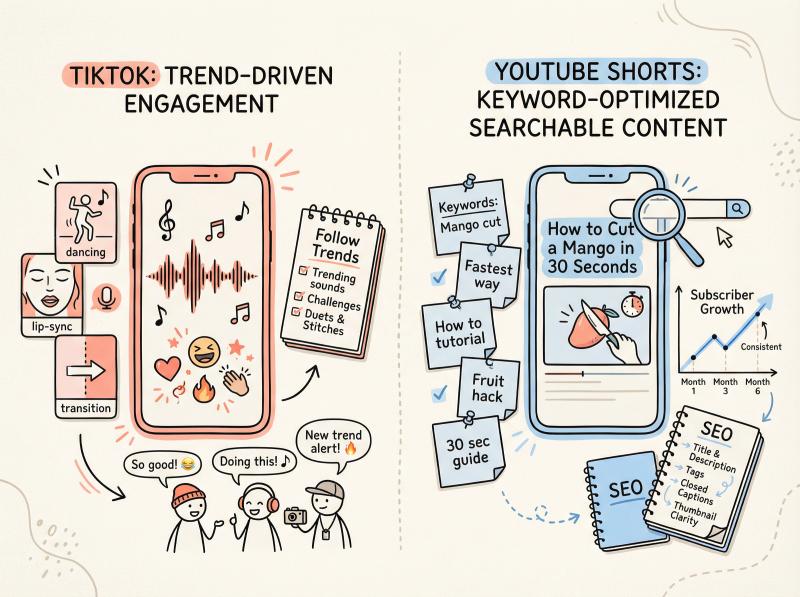
Follow and leverage trends
Spend time on your TikTok For You Page to see what's trending. Early on, try recreating popular formats or participating in hashtag challenges (with your own twist).
TikTok will reward you for engaging with trends (it's often the quickest way to get your first exposure). Use trending songs or sounds in your videos when appropriate, as this can boost your video in the algorithm (trending audio is a key discovery vector on TikTok).
Keep it short and snappy
Although you can post long TikToks, as a newbie it's better to start with 15 to 60 second videos. Hook the viewer in the first 1 to 2 seconds (with a bold visual or question) (attention spans are short).
Fast-paced, engaging content tends to perform well. Jump cuts, captions, and an interesting payoff or punchline all help retain viewers till the end (completion rate is an important metric).
Engage with the community
Reply to comments on your videos (show viewers there's a person behind the account). You can even use TikTok's reply-with-video feature if someone asks a great question, turning it into new content.
Also, comment on other creators' videos in your niche. Sometimes a clever comment can get likes and draw people to your profile. Building a presence within TikTok's community can steadily grow your following.
Consistency matters
TikTok's algorithm favors regular posting. Try to post a few times a week (or even daily if you can sustain it). The more data points (videos) you give the algorithm, the more chances you have for one to take off.
Don't be discouraged by duds (even top creators have videos that flop). Learn and iterate. As you post consistently (which is much easier when you use Post Bridge to schedule your content), you'll also develop your style and see what resonates with your audience.
How to Succeed on YouTube Shorts as a Complete Beginner
Optimize titles and descriptions
Unlike TikTok, YouTube has a search component. Use clear, keyword-rich titles for your Shorts so people can find them easily.
For example, titling a video "How to Cut a Mango in 30 Seconds" is better for search than "Trying this fruit hack!" while you're still small. Add a descriptive sentence in the description and relevant hashtags (e.g., Shorts, DIY) (it can't hurt for discoverability).
Use eye-catching thumbnails (if possible)
YouTube might show your Short with a thumbnail in certain contexts (like on desktop or if it appears in recommendations). By default it just takes a frame from the video.
A trick: you can add a custom thumbnail when uploading a Short from desktop (though it currently might not show on the Shorts feed, it will show if the Short is viewed on the regular watch page or embedded elsewhere).
A good thumbnail and title can help attract clicks from those who see your Short outside the Shorts feed. (Note: Through the YouTube mobile app, you can't choose a custom thumbnail for Shorts at the moment.)
Engage viewers to subscribe
Don't be shy to include a call-to-action in your Shorts. A simple line of text like "Follow for more recipes!" (well, "subscribe" in YouTube terms) or a quick verbal mention can nudge viewers to hit that Subscribe button.
Since building your subscriber base is crucial on YouTube, this can make a difference. Also, consider pinning a comment on your Short asking a question or inviting feedback (this can boost engagement and signal the algorithm).
Cross-promote your long-form content
If you have longer videos on YouTube, Shorts can be a gateway to them. You might create a teaser Short that highlights a key moment from your full video and in the caption or comments say "Watch the full video on my channel."
Even if you're just starting, you can plan to expand into longer videos later (and your Shorts audience will be the first to convert). Many successful channels use a strategy where Shorts drive viewers to their main channel content.
Just ensure each Short is still valuable on its own (don't make it pure clickbait for the full video).
For both platforms: focus on a niche or theme you're passionate about. The algorithms will try to figure out who to show your content to.
If one day you post a dance challenge, the next a cooking tip, then a gaming clip, it's harder to build momentum. Not that you can't experiment (you should when starting out), but once you find something that clicks, lean into it.
Consistency in topic/style helps the algorithm identify your target audience. And with Post Bridge automating your posting schedule, you can focus on creating great content rather than managing multiple platform logins.
Which Platform Should You Choose? (The Honest Answer)
After all this, you might wonder, "So…TikTok or Shorts?"
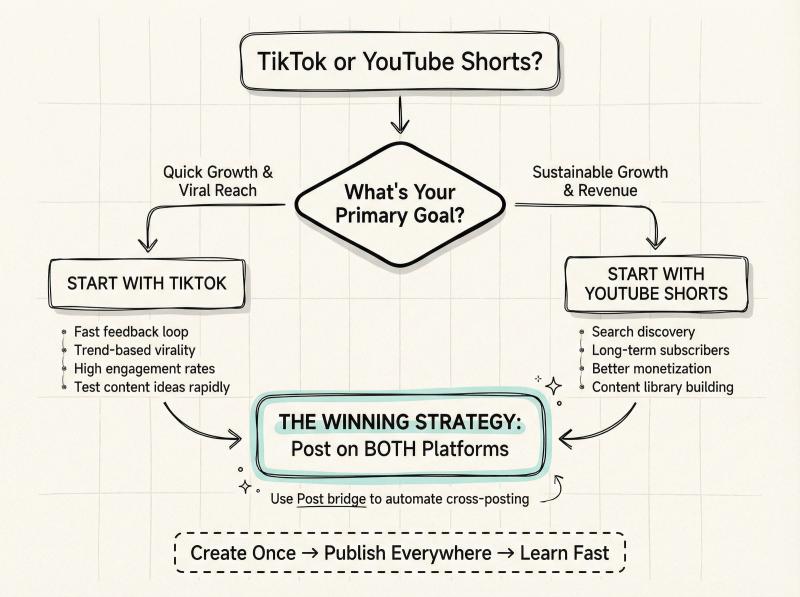
The truth is, you don't necessarily have to choose one or the other. Many creators use both to complement each other. But the right focus depends on your goals:
If your priority is quick growth and viral reach, TikTok is the place to start. You could gain tens of thousands of followers in a short time with the right content.
It's excellent for testing what content hooks viewers since the feedback loop is fast. For someone who enjoys riding trends and creating on the fly with fun effects, TikTok will feel rewarding.
If your priority is sustainable growth and building a content portfolio, YouTube Shorts might be better. Growth might be steadier, but you are simultaneously building a YouTube channel (an asset that can host longer videos, earn steady revenue, and serve as a hub for your community).
If you're camera-shy or prefer to make faceless informational content, YouTube's searchability can work in your favor with the right keywords, whereas TikTok heavily favors personality-driven, on-camera trends.
Consider your audience too: Are you targeting a demographic that lives on TikTok? Or perhaps an older or more global audience where YouTube is stronger?
For example, if you're creating content in a language or country where TikTok isn't popular or available, Shorts obviously makes more sense (and vice versa, if YouTube usage is low in your niche but TikTok is popular, go TikTok).
Many experts actually advise a multi-platform strategy for short-form content. Since making a vertical video can work on any app, why not double-post and see where you gain traction?
You might find a video blows up on TikTok but is quiet on Shorts, or the opposite. Over time, you can adjust your strategy to focus on the platform that yields the best results for you.
And as a beginner, you get the benefit of reaching two audiences with one piece of content (a big efficiency win, especially when you use Post Bridge to streamline the entire process).
Pro tip: To save time, you can use tools to schedule and post across platforms. For instance, Post Bridge lets you upload a short video once and publish it to TikTok, YouTube Shorts, Instagram, and more in one go, which can be a lifesaver when managing multiple accounts. Browse Post Bridge's comprehensive growth guide for more tips on scaling your presence.
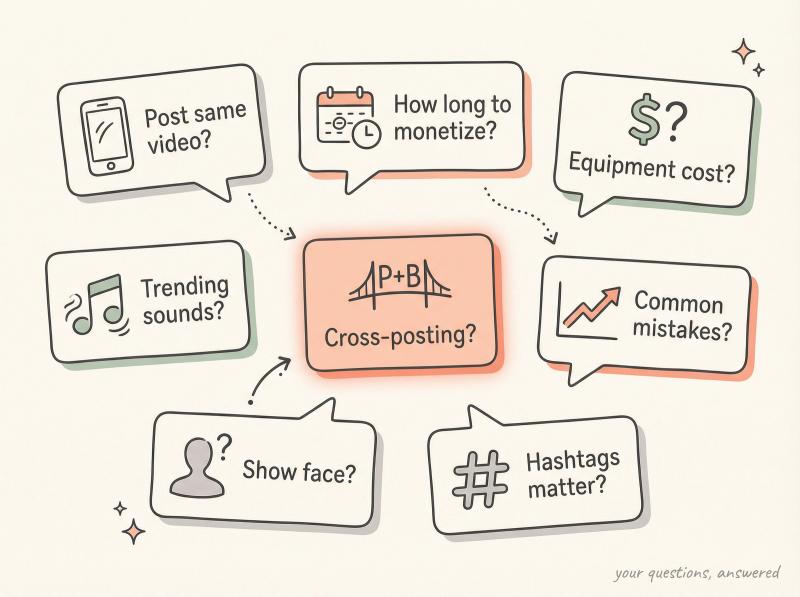
Frequently Asked Questions
Can I post the same video to both TikTok and YouTube Shorts?
Yes. Many creators repurpose content across both platforms. The key is to tailor the packaging (caption, title, hashtags) to fit each platform's culture and discovery system. Export a clean master file without watermarks and customize the presentation for each destination (much easier when you use Post Bridge's unified dashboard).
How long does it take to get monetized on each platform?
YouTube: With focused effort, some creators hit the 1,000 subscriber and 10 million Shorts views threshold within 3 to 6 months. It depends heavily on niche and consistency.
TikTok: The Creator Rewards Program has eligibility requirements that vary by region, often requiring 10k followers and 100k video views in 30 days. This can take several months to a year for most beginners.
Do I need expensive equipment to start?
No. Both platforms are designed for smartphone creators. A decent phone camera, natural lighting (or a cheap ring light), and basic audio quality are enough to start. Focus on content quality and storytelling over production value initially.
Should I use trending sounds on YouTube Shorts?
YouTube doesn't have the same trending audio culture as TikTok, but using music from YouTube's audio library can help avoid copyright issues. Focus more on searchable titles and valuable content rather than trending sounds.
How do I handle cross-posting with Post Bridge?
Post Bridge lets you connect multiple social accounts and upload once. You can customize captions and scheduling for each platform, then publish simultaneously or on a schedule. This saves hours compared to manual posting to each platform separately. Check out Post Bridge's free tools like the TikTok username checker and Instagram grid maker to enhance your workflow.
What's the biggest mistake beginners make?
Inconsistency. Most beginners post 5 to 10 videos, don't see immediate results, and quit. The algorithms need data (at least 20 to 30 videos) to figure out what works. Commit to at least 30 days of consistent posting before evaluating whether your strategy is working. Post Bridge's scheduling features make it much easier to maintain this consistency without burning out.
Can I grow on Shorts without showing my face?
Yes. Many successful Shorts creators use faceless formats: screen recordings, animations, text-based content, product demos, nature clips with voiceover, etc. YouTube's search advantage actually makes faceless content more viable than on TikTok, where personality-driven content dominates.
How important are hashtags?
TikTok: Moderately important. Use 3 to 5 relevant hashtags including trending ones when appropriate. Don't spam.
YouTube: Less important. YouTube's algorithm relies more on titles, descriptions, and viewer behavior. Use Shorts and 1 to 2 relevant topic hashtags.
Final Thoughts
Both TikTok and YouTube Shorts represent the future of bite-sized content, and both are friendly to beginners. You don't need fancy gear or a big following to start (just a smartphone, an idea, and the willingness to experiment).
TikTok might give you that adrenaline rush of instant viral potential and a pulse on the latest cultural trends. YouTube Shorts offers a foundation to build a lasting channel and potentially earn more reliable income down the road.
There's no one-size-fits-all answer to which is better. The best platform is the one that aligns with your creative style and goals.
If you can, try leveraging the strengths of each: use TikTok for its trendsetting virality and YouTube Shorts for its depth and monetization.
As one 2025 analysis aptly put it, "TikTok pays more per view. YouTube pays more long-term… You don't have to pick sides. Post on both."
In the end, great content is great content (and it will find its audience on either platform).
Now it's your turn: pick up your phone, start creating, and have fun with it. The short-form video wave isn't slowing down, and as a new creator in 2026, you have a huge opportunity in front of you.
If you want to maximize your reach without burning hours on manual posting, check out Post Bridge (it's built specifically to help creators publish consistently across all major platforms from one simple dashboard). Visit post-bridge.com to get started, and explore their comprehensive help center for setup guides.
Good luck, and happy filming!